
Chess has a reputation for being hard, but you only need a handful of rules to play a real game — and you can start playing games the same day you learn them. This guide takes you from the setup to your first checkmate, and the simple principles that win most beginner games. Everything here you can practise in our free browser version, which highlights every legal move when you select a piece.
The board and the setup
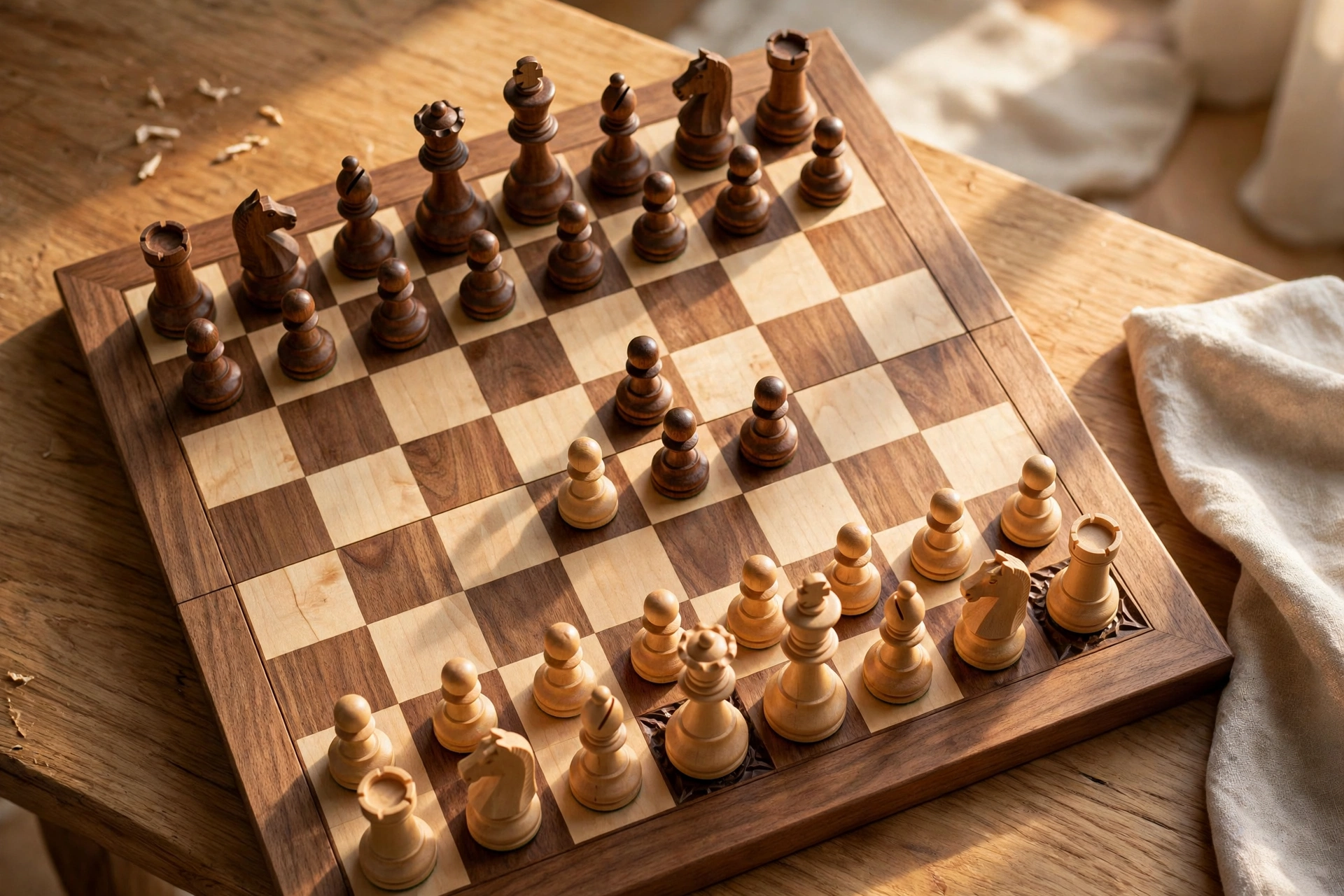
A chessboard has 64 squares in an 8 by 8 grid, alternating light and dark. Each side starts with 16 pieces on the two rows nearest to them: one king, one queen, two rooks, two bishops, two knights and eight pawns. White always moves first, and players then take turns, one move each. You capture an opposing piece by moving onto its square. The goal is to attack your opponent’s king so that it cannot escape. That is called checkmate, and it wins the game.
Set the board with a light square on each player’s right (“white on right”), and the queen on her own colour — white queen on a light square, black queen on a dark square.
How each piece moves
The pawn moves one square forward (two squares on its very first move) and captures one square diagonally forward. It never moves backwards. When a pawn reaches the far side of the board, it is promoted — usually to a queen.
The rook moves any number of squares in a straight line, horizontally or vertically. It is the simplest piece to understand and one of the strongest in the endgame.
The bishop moves any number of squares diagonally. Each bishop stays on one colour for the whole game, which is why the two bishops complement each other.
The queen combines the rook and the bishop: any number of squares in any straight or diagonal direction. She is the most powerful piece on the board.
The knight moves in an L-shape: two squares in one direction, then one square to the side. It is the only piece that can jump over other pieces, which makes it tricky in crowded positions.
The king moves one square in any direction. He is the piece you must protect — lose him and the game is over.
Piece values help you judge trades: pawn 1, knight 3, bishop 3, rook 5, queen 9.
Check, checkmate and stalemate
When your king is under attack, you are in check. You must get out of check on your next move — by moving the king, capturing the attacker, or blocking the attack. If there is no legal move that gets you out of check, that is checkmate, and the game is over.
If it is your turn, you are not in check, and you have no legal move at all, the game is a stalemate and ends in a draw. Beginners lose many winning positions to stalemate by accident, so learn to spot it: when your opponent has only a king left, leave them room to move.
Draws also happen by agreement, threefold repetition, or when neither side has enough pieces left to checkmate.
The three special moves
Castling is the only move where two pieces move at once: the king slides two squares toward a rook, and the rook jumps over to the other side of the king. It tucks your king safely into a corner and brings a rook into play. You cannot castle if the king or that rook has already moved, if there are pieces between them, or if the king is in check or would pass through check.
En passant is a special pawn capture. If an enemy pawn moves two squares forward and lands beside your pawn, you may capture it as if it had only moved one square — but only on your very next move.
Promotion happens when a pawn reaches the far side. You swap it for a queen, rook, bishop or knight of your colour. Almost always, you choose a queen.
Five principles for the opening
You do not need to memorise long opening lines to play well. Follow these five principles and you will reach a good position in almost every game:
- Control the centre. Start with a centre pawn — e4 or d4 for White — and fight for the four central squares. Pieces in the centre control more of the board.
- Develop your pieces. Bring your knights and bishops out early, toward the centre. Do not move the same piece twice in the opening while others still sit at home.
- Castle early. Get your king safe behind pawns, usually within the first ten moves, and connect your rooks at the same time.
- Do not bring the queen out too soon. She looks powerful, but an early queen gets chased around by pawns and knights while your opponent develops for free.
- Before every move, ask: can it be taken? At the beginning, most games are lost by simply leaving pieces where they can be captured for free. Check whether any enemy piece can reach your destination square.
Beginner-friendly openings
Two openings cover most of what a beginner needs. As White, the Italian Game (1. e4 e5 2. Nf3 Nc6 3. Bc4) develops quickly, aims at the weak f7 square, and teaches natural piece play. As Black, answering 1. e4 with 1… e5 and following the same development ideas keeps things simple and sound. Do not worry about memorising lines — understand the ideas behind the moves and the positions will make sense.
The traps and tactics every beginner should know
The two tactics that win the most beginner games are the fork — one piece attacking two enemy pieces at once, so your opponent can only save one — and the pin, where a piece cannot move because a more valuable piece sits behind it. Watch for the four-move Scholar’s Mate too: develop a knight early and do not weaken f7, and it never works against you.

A simple practice plan
Week 1: play the computer on Easy until you win comfortably, focusing on not leaving pieces undefended. Week 2: learn one opening as White and one response as Black. Week 3: play longer games (15 minutes per side) and review each loss to find the one move where it went wrong.
Ready to play?
You can learn how all the pieces move in an afternoon. Becoming a confident player takes regular practice over weeks and months, but you can enjoy real games from your very first day. Play our free Chess game in your browser — no download, no account — and try the opening principles in your first match. If you enjoy board games, try Checkers next, or read our guide on How to Play Ludo Online. Browse every board game on the Games page. New to checkers? See our How to Play Checkers Online guide for the rules and tips.
Best board games: Best Board Games Online Free to Play in 2026
Pingback: Best 2 Player Games to Play With Friends
Pingback: How to Play Ludo Online: Rules, Tips and Winning Strategy
Pingback: 10 Best 2, 3 and 4 Player Games to Play With Friends and Family