
Dominoes is one of the oldest tile games in the world — played on every inhabited continent, in dozens of regional variants — and it is also one of the easiest to learn. The rules fit in one paragraph, a game takes ten minutes, and a child can beat an adult on a good day, which is exactly why it never gets old. This guide covers how to play dominoes online: what you need, the setup, how a turn works, the three versions you will meet, how scoring works, and the tips that tilt the game in your favour.
What you need
Dominoes is played with a set of rectangular tiles, each divided by a line into two halves showing 0 to 6 pips. The classic Western set is the double-six set: 28 tiles, covering every combination from 0-0 to 6-6, and it is all two to four players usually need. Larger sets exist — double-nine, double-twelve — but they are for bigger groups and longer games. Online, the set is handled for you: the tiles are dealt, the boneyard is managed, and you just play. Two to four players is the standard table; the game on our Dominoes page covers all of them, with computer players filling any empty seat.
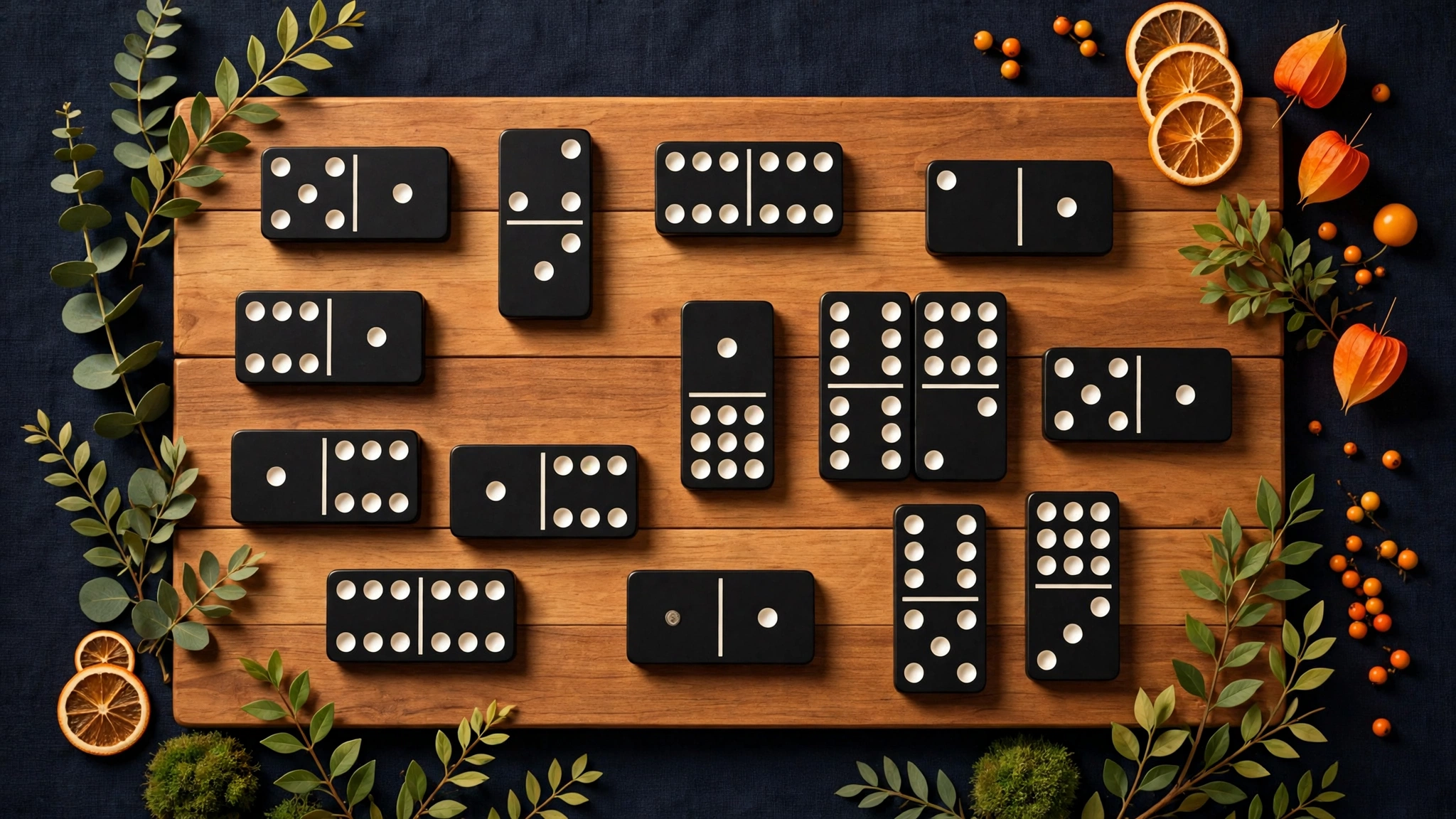
Setup — shuffle, draw, start
Shuffle the tiles. Turn all 28 tiles face down and mix them thoroughly. This pile is traditionally called the boneyard (also the stock, or the sleeping tiles). Draw your hand. Each player draws tiles without showing them to the others: 7 tiles each with two players, 5 tiles each with three or four players. The rest stay in the boneyard. Decide who starts. The player holding the highest double — 6-6 first, then 5-5, and so on — plays it first as the opening tile. If nobody holds a double, reshuffle and draw again, or let the highest-value tile lead — house rules vary, and online the game decides for you.
How a turn works
Play passes clockwise. On your turn, you add one tile to an open end of the layout, matching the number of pips: a five must touch a five, a blank must touch a blank, and so on. The matching half connects to the open end; the other half becomes the new open end. Doubles are laid crossways — perpendicular to the line of play — which can open two new directions and change the shape of the game. If you cannot match either open end, what happens next depends on the version you are playing: in Block you pass, in Draw you draw from the boneyard until you can play (or until it is empty). A round ends in one of two ways: a player lays their final tile and “goes out”, or the game becomes blocked because nobody can play.
The three versions: Block, Draw and Muggins
Block Dominoes is the simplest and the best place for families to start. Match the ends, be the first to go out — and if you cannot play, you pass. No drawing, no scoring during play, just the race to empty your hand.
Draw Dominoes is almost the same as Block, with one twist: when you cannot play, you must draw tiles from the boneyard until you get one you can play. It is the version most people grew up with, and it makes the game longer and more forgiving — a bad hand is not a lost game, because the boneyard might save you.
Muggins (All Fives) is the scoring version, and the one serious players prefer. Here you score during play: whenever the open ends of the layout add up to a multiple of five, the player who created that total scores those points. It turns every move into a calculation — not just “can I play?” but “can I play and make the ends total five, ten or fifteen?” If you like dominoes and want more depth, Muggins is the version to learn next.
Scoring and winning
In Block and Draw, the goal is to be the first player to empty your hand. When a player goes out, they score the total pip count left in all opponents’ hands — so holding heavy tiles late is costly. If the game blocks (no one can play and the boneyard is empty), the player with the lowest pip count in hand wins that round and scores the total pips in all other hands. Games are typically played to a target score of 100 or 200 points over multiple rounds, so one bad round never decides the match. In Muggins, the points you score during play count toward the same target, which makes every single move matter from the very first tile.
Tips that win games
Play heavy tiles early. A 6-5 in your hand at the end of a round costs you 11 points. Get the heavy tiles out while you still have options, and keep the light ones for the endgame. Shed doubles early. Doubles are hard to play late — they only match one number — so play them while the board is still open. Watch what opponents lack. When a player passes, they hold nothing matching those open ends. Steer play toward those numbers to block them. Control the ends. The two open ends are the whole game: if you can make both ends show numbers you hold and your opponents do not, you control the table. In Muggins, think in fives. Before you play, add the open ends in your head — if your tile makes them total five, ten or fifteen, play it, even if it is not your best tile otherwise.
Dominoes vs Ludo — which to play
Both are classic games for two to four players, but they play differently. Ludo has captures, choices and strategy: you decide which token to move, and you can send rivals home. Dominoes has no dice and no captures — just tiles, matching ends, and the quiet strategy of hand management — which makes it the better game when you want to think, and the better game for players who like a slower pace. If you want a game with dice and drama, play Ludo: read our How to Play Ludo Online guide. If you want a game with tiles and tactics, play dominoes.

Ready to play?
Open our free Dominoes game and start a match — solo against computer players, or pass the device around with friends. For another classic board game, try Checkers for a duel, or browse all board games on the Games page. New to checkers? See our How to Play Checkers Online guide for the rules and tips.
Sources
how to play dominoes: Block, Draw, and Muggins rules and dominoes rules: how to play dominoes.