
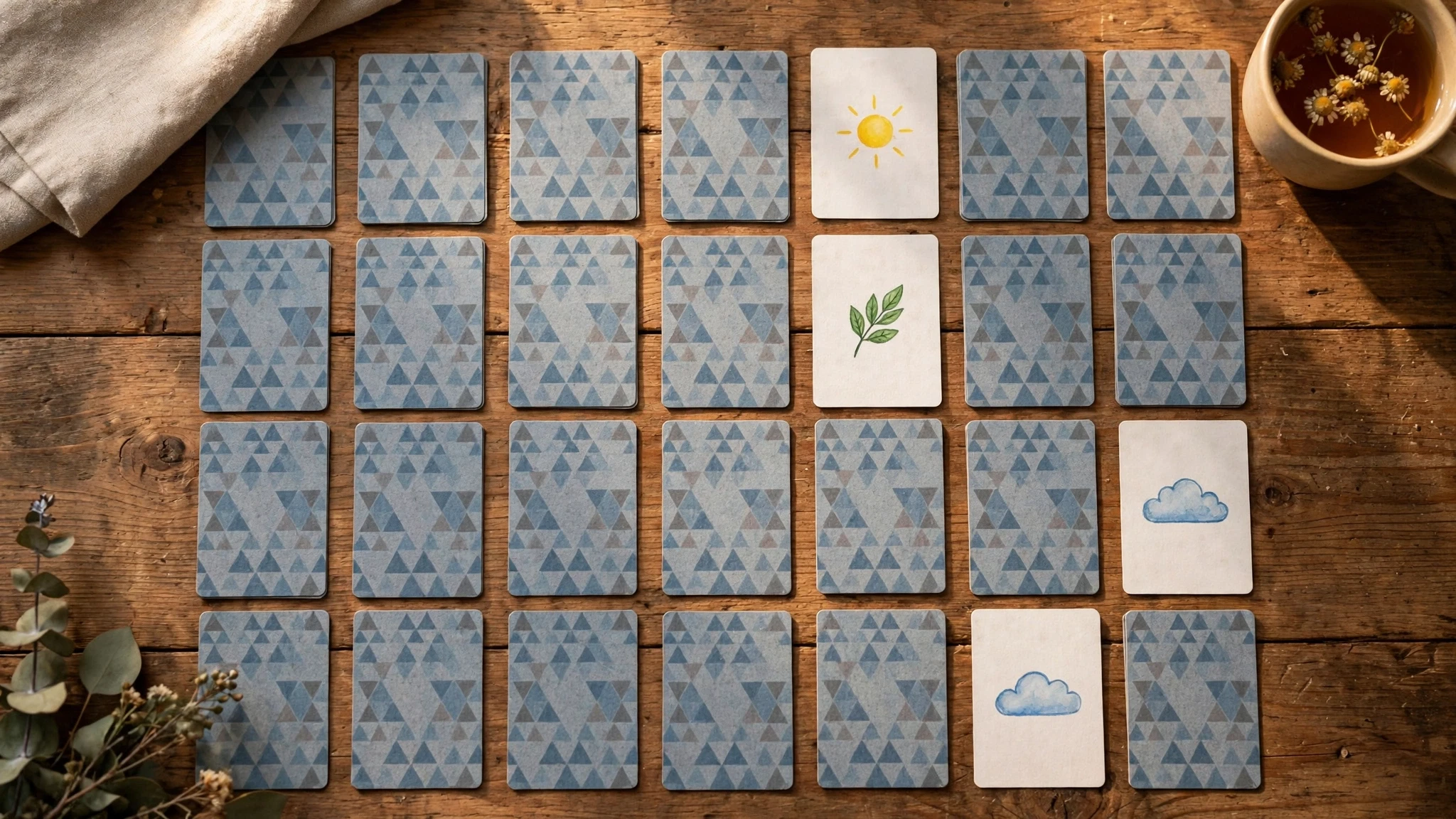
Memory Match Cards is the simplest game on this site and the most honest test of your memory: a grid of cards, all face down, and every card has a matching pair hiding somewhere in the grid. Flip two cards, and if they match they stay face up; if they do not, they flip back down, and you have to remember where they were. That is the whole game, and it is harder than it sounds — after ten flips, the board is a blur of pictures you half-remember, and the pair you need is always the one you saw three moves ago. This guide explains how to play memory match cards online, the method, and the habits that help you remember every pair — and it works on the free Memory Match Cards on this site, which plays right in your browser with no download and no sign-up needed.
How the game works
The board starts with all cards face down. Click a card and it flips over to show a picture; click a second card and it flips too. If the two pictures match, both cards stay face up and you have found a pair. If they do not match, both cards flip back down after a moment, and the board looks exactly as it did before — except now you know two cards that you did not know a moment ago. The game ends when every pair is found, and the score is usually the number of flips or the time it took: fewer flips means a better memory. There is no timer chasing you and no enemy to beat — the only opponent is your own memory, and the only skill is remembering what you have already seen.
How to play memory match cards online: flip in a pattern
The single most important habit is to flip in a pattern, not at random. Pick a starting corner and work across the board row by row, or column by column, so every flip teaches you something about the cards in order. Random flipping teaches you nothing — you see a card, forget where it was, and see it again three moves later as if it were new. A pattern does the opposite: when you flip a card, you know its neighbours, and when you see its pair, you know exactly where to find the first one. Say the picture out loud as you flip it, or name it in your head — “cat”, “star”, “ball” — because a named card is a remembered card. Players who flip in a pattern finish in half the flips of players who flip at random — and the difference is not memory, it is method.
Remember what you have seen
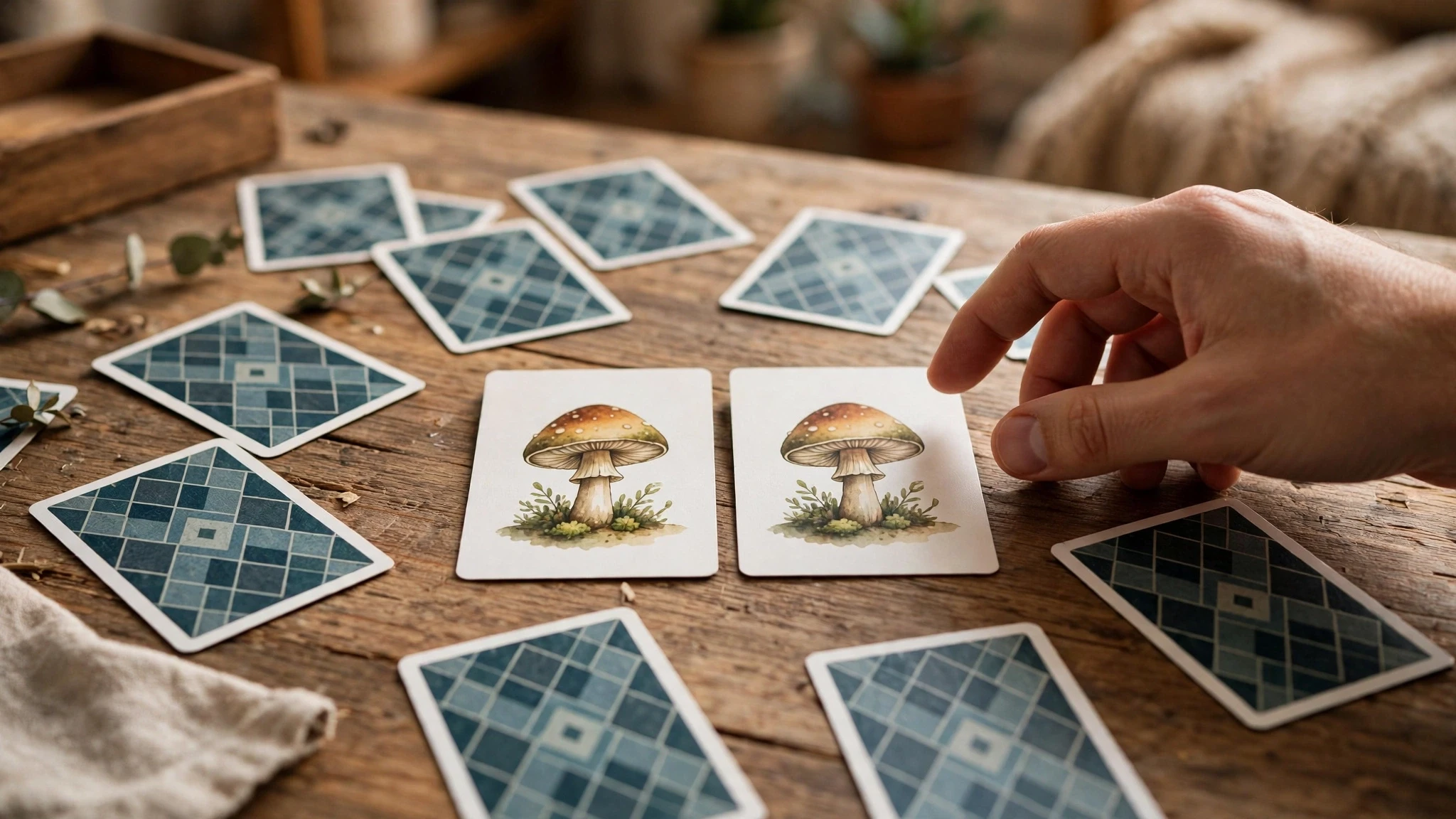
The game is won in the remembering, not in the flipping. Every time a card flips back down, it leaves a fact behind: that picture is in that place. The players who win are the ones who collect those facts instead of letting them go. Two tricks help. First, when you flip a card that does not match, look at it for a full second before it flips back — a second of attention is worth more than a glance. Second, work in small areas: finish one corner before you move to the next, so the pairs you need are always near the cards you have just seen. And when you find a pair, flip it at once — the pair you have found is the pair you will forget if you delay.
Start small, then raise the board
If the full board feels impossible, start with a smaller one: fewer cards means fewer pairs to hold in your head, and a small board finished well teaches the method faster than a big board finished badly. Play the same board size until you can finish it in a steady number of flips, then raise the size. The jump from a small board to a big one feels hard for a day, then easy, because the method is the same at every size: flip in a pattern, name every card, remember every flip. Children learn this game faster than adults, because they flip slowly and look carefully — and that is the lesson for everyone else. Our best memory games roundup has more games that train the same skill, and our best brain games roundup has the full set of thinking games on this site.
Mistakes that slow you down
Four mistakes cost memory players the most flips. The first is flipping at random, so every card is a surprise and nothing is ever remembered. The second is flipping fast, so the card flips back down before you have really seen it. The third is forgetting the pairs you have already found — finding a pair and then flipping somewhere else instead of taking it at once. And the fourth is playing a board that is too big for your current skill, so the game feels like guessing instead of remembering. How to play memory match cards online is a simple question with a simple answer: flip in order, look carefully, remember everything — and the board will clear itself, pair by pair.
Outbound links:
https://en.wikipedia.org/wiki/Concentration_(card_game) — Wikipedia: Concentration, the classic memory card game