
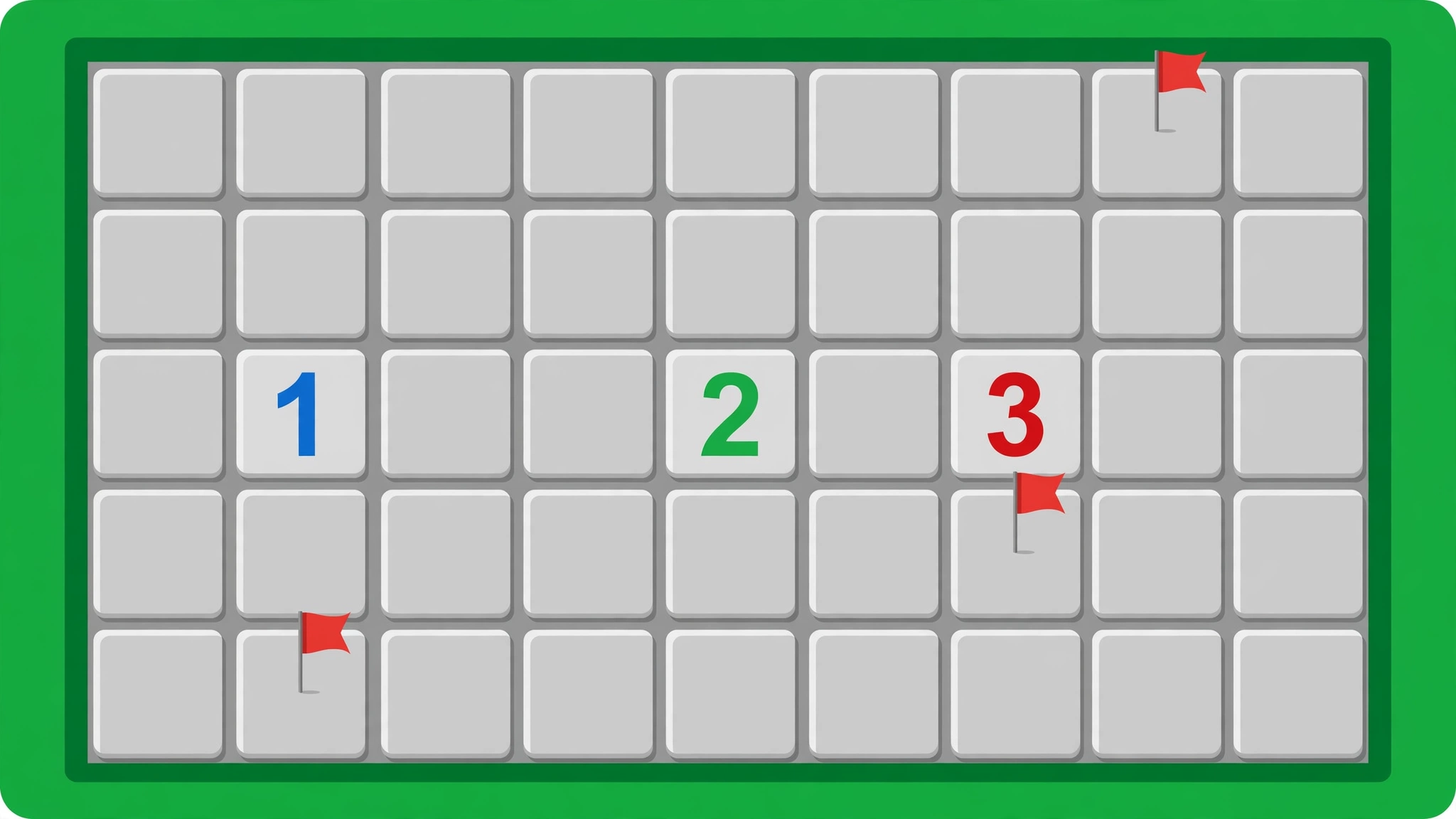
Minesweeper is the oldest puzzle on this site and the most honest test of logic: a grid of squares, some of them hiding mines, and the only clues are the numbers that appear when you click. There is no luck in a good game — every square you open should be a square you have reasoned is safe, and every mine you flag should be one the numbers have told you about. It looks like guessing for the first minute, and then the numbers start talking, the safe squares open in waves, and a board that looked impossible clears itself one careful click at a time. This guide explains how to play minesweeper online, the rules, and the habits that clear the board without hitting a mine — and it works on the free Minesweeper on this site, which plays right in your browser with no download and no sign-up needed.
How the game works
You start with a grid of covered squares. Click a square and one of two things happens: it shows a number, or it shows a mine and the game is over. The number tells you exactly how many mines touch that square — counting all eight neighbours, including the diagonals. A 1 means one mine nearby; a 3 means three. Your job is to use those numbers to work out which covered squares are mines and which are safe, flagging the mines and opening the safe squares. The board clears in waves: open a square with no mines around it and the game opens the whole empty area for you, revealing a patch of numbers to work from. The game ends when every safe square is open and every mine is flagged — or the moment you click a mine. A right-click — or a long press on touch — places a flag on a square you believe is a mine, and flagging is how you keep track of what you have already worked out.
How to play minesweeper online: read the numbers
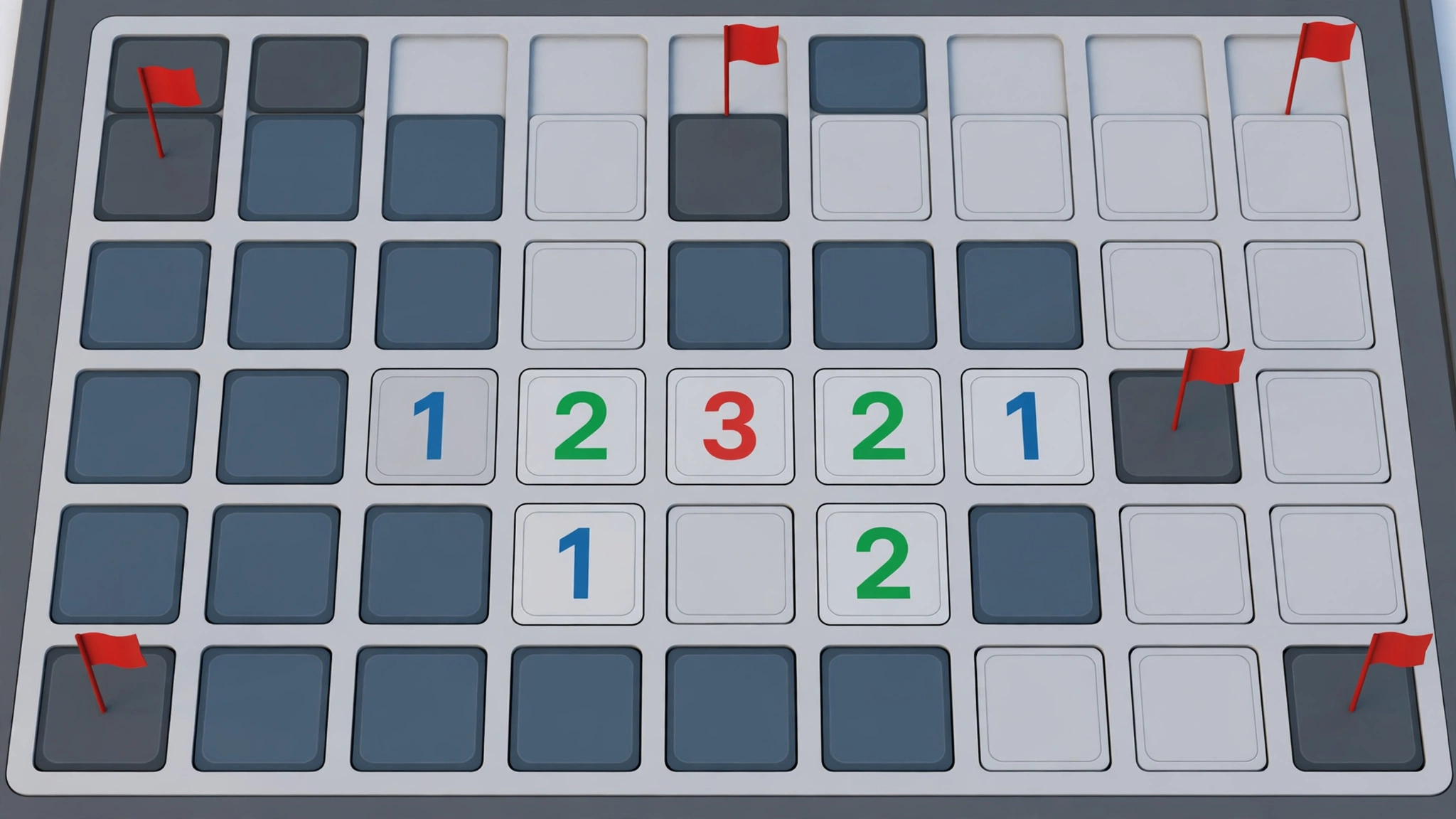
The numbers are the whole game, so learn to read them before you click anything. A 1 touching only one covered square means that square is a mine — flag it. A 2 touching exactly two covered squares means both are mines. And a number whose mines are already flagged tells you the rest of its neighbours are safe — open them. The habit to build is this: never click a square you have not thought about. Look at each number, count its covered neighbours, count its flags, and only then decide. The players who win are not the ones who click fastest: they are the ones who read every number on the board before they touch a single square, because one careful look saves ten careless clicks.
Start in the corners, flag as you go
The corners and edges are the safest places to start: a corner square has only three neighbours, so its numbers are easier to read than a square in the middle with eight. Open a corner first, read what it tells you, and let the cleared area grow from there. Flag as you go — every mine you find should get a flag at once, because a flag is a fact: it tells every number around it that one of its mines is accounted for, and it stops you from clicking that square by mistake later. And when the board goes quiet and no number gives you a certain move, do not guess blindly: look for the number with the fewest unknown neighbours, and take the smallest risk you can find. A guess on a square with a one-in-two chance beats a guess on a square with a one-in-five chance, and the best players guess as rarely as possible. And when you open a square that shows no number at all, the game clears the whole empty area around it for you — that open space is a gift, because every number it reveals is a new clue, and a board that starts with a big empty area is a board that is already half solved.
Mistakes that end the run
Four mistakes end more Minesweeper games than anything else. The first is clicking at random at the start, before the numbers have given you anything to work with. The second is forgetting to flag — a mine you found but did not mark is a mine you will click later. The third is reading only one number at a time, when the answer is usually in two numbers together: the square that is safe is the one two different numbers both agree about. And the fourth is guessing when a careful look would have found a safe square — most stuck boards have a safe move hiding in plain sight. If a game ends on a mine, think about which of the four it was, fix that one thing, and play again. How to play minesweeper online is a simple question with a simple answer: read the numbers, flag what you know, guess as little as possible — and the board will clear itself, square by square.
Outbound links: https://en.wikipedia.org/wiki/Minesweeper_(video_game) — Wikipedia: Minesweeper, the game